Grapevine Stories
Are We Driving the Curlew to Silence and Extinction?
Ian Coghill is a game shooter, wildfowler, fisherman, lifelong conservationist and author of ‘Moorland Matters'. Ian talks about why Curlew Day is a wake-up call—learn why this beloved bird is vanishing, what’s driving its decline, and what controversial solutions could save it before it's too late.
As part of Grapevine’s partnership with Scribehound, the digital platform that gives 33 leading rural voices the freedom to discuss the topics that matter the most to the countryside. Grapevine members can feed their passion for the countryside with an original column shared everyday, whilst taking advantage of an exclusive offer of a 3 month free trial and 40% off an annual subscription. Please click here to sign up

This Saturday was World Curlew Day. Having your own day is never a good sign. Unlike most people, I see a lot of curlew. I see them when I'm wildfowling. Their morning flight out to the fields in ragged musical skeins is a joy. I see them when I migrate, as they do, to the grouse moors of the Pennines in the spring. Their songs are the essence of these wild places and watching them with their ludicrously carefree chicks lifts my spirits in a way that little else can.
It would be easy for me to think that because they are still a feature of my life that all is well. We know that is not the case. I used to see them when I fished the upper Wye. They are gone. Replaced by a sky full of red kites waiting for the dinner bell at their feeding station. They used to nest on Midland hay meadows and West Country moors, but they are gone driven out by silage, predators, and out of control dogs.
This wonderful bird is in serious and potentially terminal decline. There has been a 60% population decline since the beginning of the 1970's. What is driving the decline of curlew? We know, and we know what must be done to stand any chance of saving them. There are at least 5 major problems that the birds face.
The passion for trees
There have been many reasons for planting trees. Many are illusions. Unlike most crops, trees are harvested 40 or more years after they are planted. It is difficult to know what the potato market will be this year let alone what the timber market will be in 2070. Remember the projected demand for poplar to make match sticks? At Keilder, the 1750 pairs of curlew displaced when the largest extent of blanket bog ever drained in England was planted with trees, were sacrificed to provide pit props for a mining industry that no longer exists.
The latest justifications are that forests will contribute to attaining net zero, stop the UK being one of the most nature-depleted countries in the world, stop flooding, are more natural than open landscapes, and oddest of all, that other European countries have more trees. Most of these reasons are completely or partly bogus. The only real reasons for planting trees: that you like trees and/or want to make a living by eventually cutting them down, whilst sensible, are hardly ever mentioned. Even commercial forestry is now a bigger gamble; with the global surge in species specific diseases, who knows if what you plant will ever be harvested?
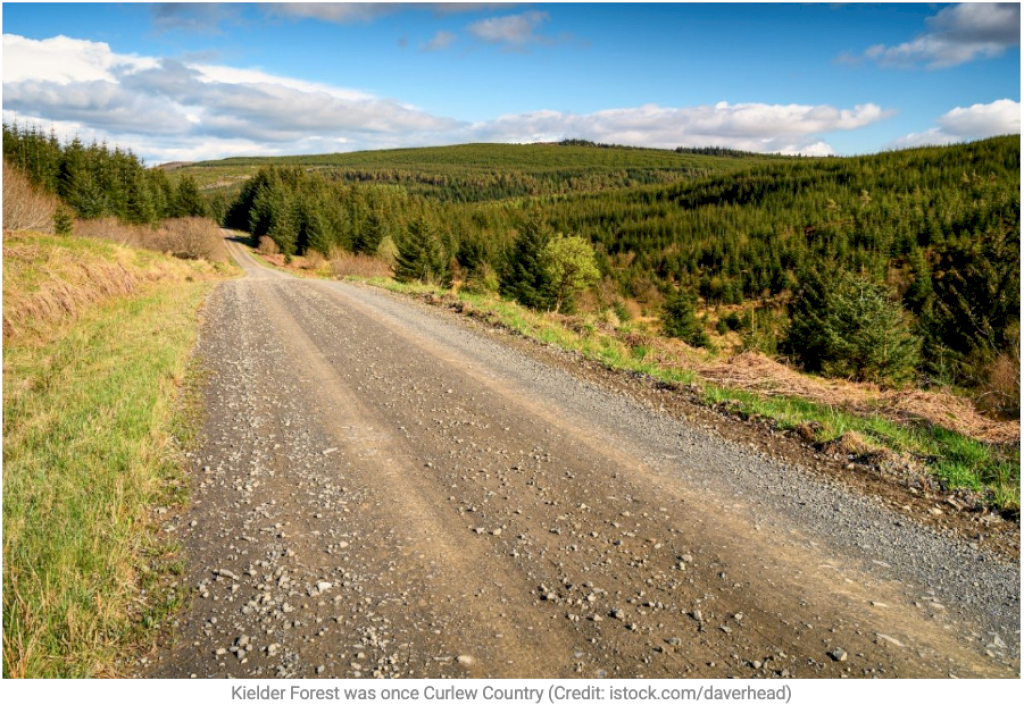
But whatever the reason, the politicians have decided that we must plant more trees. A lot more trees. If they go into the last remaining curlew breeding areas the result could be catastrophic. Curlew don't breed in woods, they don't even breed near them. A hectare of new wooodland is over ten hectares lost to curlew. The UK has a target of planting 30,000 hectares of new forest every year to reach a 2050 total increase of 800,000 hectares. That is over 13 Keilder forests. If they were all planted on curlew ground, the curlew would be gone.
The grass is sometimes too green
Things started to go down hill for ground nesting birds when the scythe went out of general use. When hay was cut long and late by a line of men swinging scythes, most ground nesting birds had fledged, or if they hadn't, they could simply run out of the way. Even the pace of a horse drawn hay mower was too much for some, made worse by the new system of mowing from the outside into the middle, cutting off the old escape route provided by a scything line.
The whole thing got worse again with mechanisation, but it was silage that finished everything off. Cutting fast, early and often in fields that look ideal nesting sites is a disaster. The situation can be recovered, but only at an on-going cost that no one seems prepared to pay.

Disturbance
No one wants to talk about disturbance. Spring and summer are critical times for ground nesting birds, Their breeding season coincides with the onset of better weather and two Bank Holidays. The Peak District National Park had 13 million visitors last year, the Lake District nearly 20 million and rising. Most were during the curlew breeding season.
People used to want to walk quietly and admire the beauty of the moorland landscape. Now we have wild hang gliding, wild drones, wild camping, wild driving, wild parking, wild cooking, wild mountain biking, wild fell running (both of these at night), wild toileting and wild dog walking. You can probably add a few to that list.
Even people dedicated to saving curlew from extinction are well advised to say nothing about the mayhem and usually don't... except in private. To do otherwise marks you down as an elitist and an exclusivist. It is safer not to notice that the huge swathes of the country where public access makes it almost impossible for birds like curlew to survive.
Habitat
There is more good curlew habitat than there are curlew to use it. In that sense habitat is not a limiting factor. But habitat has an impact. Upland drainage has created better grass, but it is drier. That effects the number, nature and availability of invertebrates that the curlew chicks must feed on. The better they are fed, the better they are at avoiding predation, and the quicker they fledge, and every day counts.
There are other factors coming into play as conservation fashions change. Curlew, like most wader, detest scrub. Predators hide in it, the chicks can't get about in it, and they can't find the food they are looking for. Every top down plan for the uplands is very keen on increasing scrub. In the Peak District, the National Trust has a project called, 'Let's scrub up'. An amusing play on words, but the curlew didn't think it was funny.
Good habitat can be counter-productive. At Loch Leven the RSPB has created perfect habitat for waders, who are attracted to breed. Unfortunately, without effective control of predators all the eggs and chicks are eaten, and the effort and resource simply creates another 'wader sink'.

Another issue is the banning of rotational cool burning. Curlew, in common with other waders such as golden plover and dunlin, select burns a few years old as nest sites. They are also prime foraging areas for growing chicks, as are grassy areas amongst the heather. In the emerging top down plans for our moorlands, these important breeding sites are intended to disappear. There will be no burning (except of course wildfires), no cutting, and the grass will be turned into scrub.
Predation
Most of the foregoing will cause little disagreement. Even the idea that you can have too many nocturnal Fell Runners will be accepted behind closed doors, and lately the good old RSPB has tentatively taken a slightly firmer line on out-of-control dogs, although nothing too abrasive, and obviously nothing about cats. Predation is a very different matter.
There is overwhelming evidence that, all across Europe, the main cause of the decline of curlew, and a suite of similar open-country waders and other ground nesting birds, is predation by common generalist predators. In Britain the Otterburn Study made the critical importance of effective predator control crystal clear nearly twenty years ago. Since then people who don't like the idea have spent millions of pounds to disprove the Otterburn Study. They have failed, but worse, they have wasted years, and ever more curlew have been lost.
Everyone knows the truth. They may not like it, but they know it. One of the greatest ornithologists of his generation, Ian Newton OBE, Chairman of RSPB in the days when their policies were based on science rather than ideology, wrote the following in his book 'Uplands and Birds'.
“Many of these species (40 bird species) are maintaining their numbers on managed moors but declining elsewhere... waders in general are up to 5 times more abundant on moors managed for red grouse than on unmanaged moors, and that, owing to predator control, they can have three times better chance of fledging chicks”.
The RSPB has been involved in most of the frantic search for a habitat-based solution and we should be grateful for their efforts. What they have proved is that Otterburn is correct. Nowhere - without predator control - is it possible for curlew to produce enough fledged offspring to naturally sustain their population. They have spent nearly £20 million in the process, but happily most of that was from taxpayers and had no impact on their booming financial reserves.
The RSPB Curlew Trial Management Project
In England, even with hatching as the measure of success (which of course it isn't) it is only fledging that counts, the RSPB's predator control and habitat management failed to get outcomes as good as the control sites where they did neither. They are clear that gamekeepers outperform them by a country mile, but they struggle to explain why. Bizarrely, the favoured reason is the presence of released game birds, but then it always is.
In the real world the explanation is obvious. The professional full-time gamekeepers at Otterburn behaved as moorland gamekeepers normally do. They controlled all legal predators including stoats, all the time, and they used most of the legal methods of control. The RSPB used contractors for limited periods, limited target species (no stoats) and limited methods e.g. no traps.
The annual RSPB reports to their funders in Natural England (NE) make clear their lack of awareness of the nature of what gamekeepers and farmers deal with every day. Here are some statements they made to explain their difficulties.
'Fox control can be technically challenging on these upland sites.
'The cost of some management interventions... combined with other limitations, e.g. weather over autumn, winter and spring, may limit the amount that can done per site per year'.
'Predation control at a level sufficient to induce change in predator numbers and responses in breeding waders is challenging in upland landscapes'.
The project's lesson is that half hearted measures fail. Do it properly and it works. If you let a committee of very clever people, who have never been involved in practical predator control, and who don't really want to do it, decide how it is done, it doesn't work.
RSPB Curlew in Crisis
This 4,601,472 Euro project spanned all four of the UK's nations. We have yet to hear of the wider outcomes. RSPB don't talk about failure, so, even with the target only being 'having as many pairs at the end of the project as there were at its beginning', the news may not be good. However we know that in Antrim there has been an outstanding turnaround. A total of 69 curlew chicks fledged on the hills around Glenwherry in Northern Ireland.
The RSPB told us that
'Following intensive management work by farmers and landowners under the guidance of RSPBNI a total of 69 curlew chicks fledged in the Glenwherry area in 2022'.
There is nothing about predator control, or a grouse moor, or gamekeepers. The impression was intended to be that this success was all down to some electric fencing and habitat management directed by RSPB, and achieved without any of those awful gamekeepers or being beastly to anything. In fact the heart of Glenwherry is a grouse moor, with dedicated and hard working gamekeepers, and their predator control efforts were augmented by contractors working under their supervision in the wider hinterland.
The lesson from the Curlew in Crisis Project is that it confirms the Otterburn Study. If you have effective predator control, good habitat, and some half decent weather you can get curlew chicks fledged.
RSPB Orkney Project estimated cost at conclusion £15,668,279.71
The RSPB has spent a small fortune on eradicating stoats to protect ground nesting birds and the Orkney vole, an isolated population of the common vole, a species found all over Europe but not in the UK, except on Orkney and Guernsey. They have still a bit to do, but there are a lot fewer stoats. According to RSPB, as a result ground nesting birds have increased their rate of fledging by 300%. The lessons that can be drawn from the project are that anything the RSPB is involved in is likely to be ferociously over-priced, but far more important, that control of stoats has a massive effect on the productivity of ground nesting birds.
What does all that add up to?
I would suggest, if you take all of these together, and add in the Otterburn Study, then factor in Philip Merrick's ability to use predator control on his Elmley marshland to outperform the RSPB's identical adjacent reserve by ten to one in fledged lapwing chicks, plus the dozens of other studies that show the same thing, and what is happening all across Europe, the conclusion is obvious: Effective control of foxes, stoats and corvids is essential and it works when done well.
Does it matter?
Surely the people who do predator control properly can get on and do it, and the people that don't, can do what they do, and whilst things might not get better, at least they won't get worse.
Sadly, it matters a lot. The Labour Government is en route to make effective predator control impossible. Their English Land Use Framework contains the idea of licencing game shoots, including grouse moors. This came out of nowhere, and is as much in keeping with the nature and structure of the document, as wings on a camel. It is almost certainly there in all its oddity because the RSPB persuaded them to insert it. Their plan is to replace driven grouse shooting with walked-up. This would mean that most grouse moor keepers would disappear, along with the way of life of the community whose lives are intertwined with the grouse. That would delight the RSPB who hate them, but as Ian Newton makes clear, would sign the death warrant of curlew and the rest.
Simultaneously, there are Government reviews on the use of dogs, traps, snares and humane cable restraints, the use of live birds in Larson Traps, changes the quarry list, and the General Licence, and we have already effectively lost heather burning.
Then there is the government's plan to use the English uplands for 'Climate and Nature Benefits', this would include the huge wader factory of the North Pennines National Landscape, (NPNL). The final straw may be that, hidden in the Framework is that this will all be in line with National Landscape Plans.
This is what the NPNL Plan says about England's most important curlew factory.
“Wherever possible, conservation objectives should be delivered without resorting to the killing of predators (e.g. through good habitat management or appropriate non-lethal means). Any predator control carried out to achieve conservation objectives should be justified through evidence of its need, targeted in its approach and scale, and regularly reviewed.
As breeding wader populations are currently vulnerable, targeted predator control is required in order to ensure that populations remain viable. Such control should be undertaken alongside other measures including habitat management, and the aim should be to facilitate sustainable populations of both wader and predatory species.
The North Pennines’ role as a refuge for some declining species and habitats has the potential to conflict with nature recovery for other threatened wildlife. For example, the precipitous decline of curlew globally and in this country means that those of us working in the North Pennines have a particular responsibility to conserve conditions and habitat for them. That wading birds like curlew still breed in large numbers in the North Pennines is a source of pride to many of us, but in the context of a managed landscape with a highly unnatural predator-prey balance, keeping curlew numbers high might mean keeping tree cover low in some areas. This plan attempts to navigate these potential conflicts'.
This might seem a reasonable position, but it isn't. The plan is to ensure that populations remain viable. Viable is a long way down from where we are, and very bad news for a host of waders and catastrophic for England's curlew.
Next they say that “The aim should be to facilitate sustainable populations of both waders and predatory species”. The species of generalist predator that can that can be legally killed all have sustainable populations in the NPNL now. If control stopped the number of predators would increase in a heart beat. It's the curlew and the rest that would be unsustainable, and gone in less than a decade.
Then we have the usual stuff about evidence of need, targeting, scale and review. How much evidence of need do they want? Read the science or get out of the office and look and listen on any North Pennine grouse moor. You think you can do better? After all the large numbers of waders are 'a source of pride to many of us', so they must feel they can take some credit. Tell us where the same sustainable productivity can be found without predator control.
What does targeting even mean? Are we only supposed to kill the naughty ones? Apparently so. The RSPB's crow catchers could only shoot crows that showed learned behaviour of looking for curlew eggs. They are opportunists. That is why they do so well. Is there a crow alive that needs to be taught that a curlew egg might be worth a peck?

What is scale? Is it area? Is it number removed? Is it duration of removal? Perhaps it is all of these things, or just a word that the authors inserted to make it all sound better.
At Lake Vyrnwy, RSPB had evidence of the need for predator control. They decided on the target and the scale. Foxes, in the spring and 250 hours of night shooting by a contractor. They said they killed 24 foxes and no crows or stoats. The money was wasted and the 24 foxes were killed for nothing. Everything continued to be predated and the curlews are now extinct.
Had that been a grouse moor there would have been at least one gamekeeper present all the time. Daily contact would have given them a profound understanding of the land, how the whole suite of predators they needed to control used it, and how best to intercept them when the need or opportunity arose. At the same time they would be managing habitat, maintaining infrastructure, mitigating the inevitable effects of human beings, liaising with farmers, contractors and the community. The moor would be full of ground nesting birds, including curlew, successfully fledging chicks and there would still be some foxes, stoats and crows because there always are.
This could and should fall comfortably into a system where “Any predator control carried out to achieve conservation objectives should be justified through evidence of its need, targeted in its approach and scale, and regularly reviewed.” But this is clearly not what the NPNL Plan means. It can't be, because it makes it very clear that it wants moorland management, including predator control, to change. Why? What possible justification can there be for altering something that works for something that doesn't.
For the sake of the curlew we have left, could we not, just for once, refrain from crashing something that works. By all means fiddle about on your own land trying to find a different way of saving curlew from local extinction, but how in God's name do people who can't make it work, feel justified in telling people who can, to stop doing what works?
The people who drew up the NPNLP are not bad or stupid, nor would they consider themselves prejudiced. After all they are only doing what they all do. They have consulted the experts. The experts are neither bad nor stupid, and would not accept that they were prejudiced in any way. They have, they would say, the best intentions.
Unfortunately, the road to hell is paved with good intentions. In the context of conservation, the path that takes you onto that road by-passes the people who own, and farm, and manage the land. Who needs their knowledge? After all they are the problem; it is their ways that must be changed. That much the plan makes clear.
When those ways have been changed, and the knowledge and skills are gone, you will find that the curlew and the rest are gone with them.
That is not speculation. You merely have to look at where this has already happened. In fact, you don't even have to look. Listening is enough.
Just listen to the silence.
By Ian Coghill
Do take advantage of an exclusive Grapevine offer of a 3 month free trial and 40% off an annual subscription. Please click here to sign up
Grapevine is a trusted network of private members, linking kindred spirits from town or country. Members promote, sell or buy goods and services within the network.
Grapevine also believes in supporting young people to get a strong start through internships and work placements. We also help a number of charities including Heads Together and The Injured Jockeys Fund.